



Dubai’s Infinity Bridge has quickly become one of the city’s most talked-about landmarks, blending striking design with real functionality. As part of the Al Shindagha Corridor Improvement Project, Dubai’s Infinity Bridge connects two historic districts, Al Shindagha in Bur Dubai and Al Ras in Deira, while sitting at the centre of one of the emirate’s busiest transport arteries.
If you’ve been following Dubai’s rapid development, this bridge is a great example of how the city continues to evolve with purpose, ambition, and eye-catching design.
In this guide, discover:
- Key features and design of Dubai’s Infinity Bridge
- Construction and engineering of Infinity Bridge in Dubai
- Functionality and accessibility
- Lighting and aesthetics
- Significance and impact of Dubai Infinity Bridge
- Key takeaways
- FAQs
Key features and design of Dubai’s Infinity Bridge
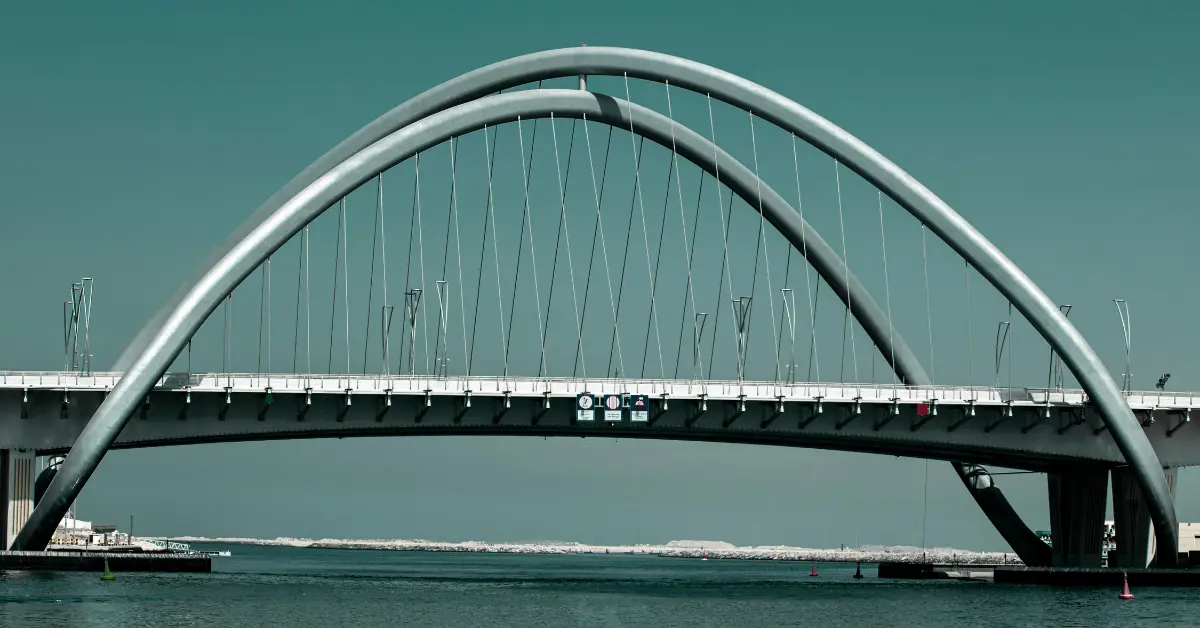
Dubai’s Infinity Bridge blends a streamlined infinity-shaped arch with practical design. This offers smooth movement for vehicles, pedestrians, cyclists, and marine traffic. The infinity-shaped arch alone signals the city’s ambition for progress and continuity, making it a landmark tourists seek out while exploring Dubai’s popular attractions.
Dimensions and structure of Dubai’s Infinity Bridge
The bridge’s infinity arch instantly stands out. Formed by two diagonally placed steel arches, it mimics the mathematical symbol for infinity, representing Dubai’s limitless vision.
Key design and structural features include:
- Length: 295–300 metres
- Width: 22 metres (expanding to 55 metres at its widest)
- Height above the creek: 15.5 metres
- Infinity arch height: 42 metres
- Number of lanes: 12 lanes, six in each direction
- Pedestrian and cyclist path: A dedicated 3-metre path
- Marine Navigation Passage: A 75-metre-wide corridor
The project used approximately 2,400 tonnes of steel, and the arch was assembled on-site using cranes positioned on both banks of Dubai Creek. Forty steel segments—some weighing up to 130 tonnes were lifted and fixed into place over six months.
This makes the bridge not just beautiful to look at but also an impressive engineering accomplishment worthy of being mentioned alongside some of Dubai’s most iconic works.
Architectural inspiration behind Dubai’s Infinity Bridge
The signature feature of Dubai’s Infinity Bridge is the steel arch shaped like the infinity symbol.
- Two steel arches are placed diagonally across the deck with a span of roughly 135 metres between their piers, creating the continuous loop that can be seen from the water, the road, and even nearby buildings.
- The infinity shape is a nod to Dubai’s long-term vision: continuous growth, connection, and opportunity.
- Around 2,400 tonnes of steel were used for the arch, which was prefabricated in sections, then transported and assembled on site.
Construction and engineering of Dubai’s Infinity Bridge
Dubai’s Infinity Bridge was delivered as part of a much larger transport upgrade that spans multiple interchanges and corridors around the mouth of Dubai Creek.
Construction details of Dubai’s Infinity Bridge
The bridge was constructed by BESIX Construct LLC, the regional subsidiary of Belgian contractor BESIX, under the supervision of Dubai’s Roads and Transport Authority (RTA).
The arch itself was one of the most complex elements.
- Forty steel segments, some weighing up to 130 tonnes, were prefabricated, transported to the site, and lifted into place using heavy cranes positioned along both sides of Dubai Creek.
- This phase alone took around six months, with careful coordination to keep marine traffic moving.
The main bridge structure was completed earlier in the decade, and additional work on the wider corridor continued. Then the route officially opened to full traffic in 2025.
Cost and investment behind Dubai’s Infinity Bridge
Dubai’s Infinity Bridge forms part of a major infrastructure investment around the Al Shindagha Corridor. The bridge itself cost approximately USD 102–105 million (around AED 394 million), while the wider corridor and connecting projects sit within a much larger infrastructure budget of around USD 400 million.
This investment does more than reduce congestion; it also supports long-term growth in nearby districts and complements other new mega projects in Dubai that are reshaping the city’s skyline and road network.
Functionality and accessibility
Dubai’s Infinity Bridge is practical for drivers, welcoming for pedestrians and cyclists, and efficient for marine navigation.
Traffic and connectivity around Dubai’s Infinity Bridge
With 12 lanes and a capacity of up to 24,000 vehicles per hour in both directions, Dubai’s Infinity Bridge plays a major role in keeping traffic flowing between key districts.
- It links areas such as Al Hudaiba, Al Raffa, Al Jafiliya, Al Mankhool, Al Kifaf, and Al Karama.
- The 13 km Al Shindagha Corridor that includes Dubai’s Infinity Bridge connects residents to major developments like Dubai Islands, Dubai Waterfront, Dubai Maritime City, and Port Rashid.
This improved access has a natural knock-on effect for property interest in nearby communities.
Pedestrian and cyclist access
Dubai’s Infinity Bridge is not just for cars. A 3-metre dedicated path for pedestrians and cyclists runs along the side of the bridge, open at all hours. From here, you can enjoy panoramic views of Dubai Creek, old Deira, and the modern skyline behind Port Rashid.
Because the bridge sits close to some of the city’s most characterful districts, it’s easy to include it in a walking or cycling route along other places to visit in Dubai, especially during the cooler months.
Lighting and aesthetics
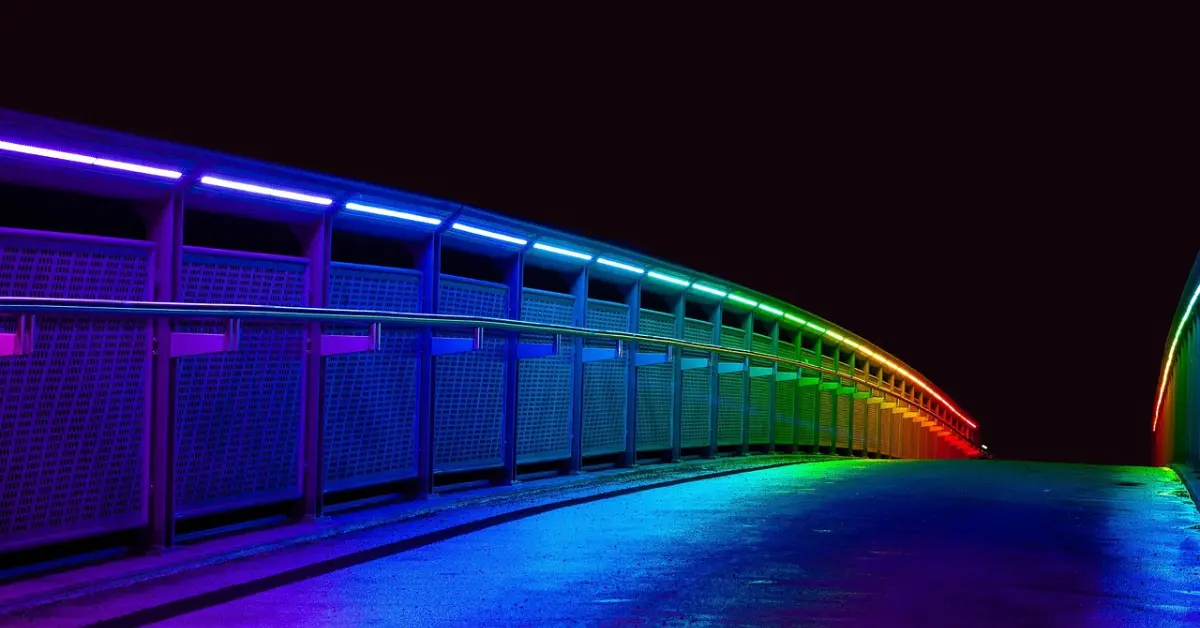
At night, Dubai’s Infinity Bridge becomes a glowing loop of light over the water. A dynamic LED system using hundreds of fixtures allows the bridge to shift colours smoothly and highlight the infinity shape.
The lighting is designed with efficiency in mind, using technology that supports Dubai’s broader sustainability goals while still creating a strong visual impact. The reflections on Dubai Creek make the bridge a favourite subject for photographers and sightseers on dhow cruises and waterfront promenades.
Significance and impact of Dubai’s Infinity Bridge
- For daily commuters, Dubai’s Infinity Bridge is a time-saver, helping reduce congestion and creating more direct routes between Bur Dubai, Deira, and the wider coastline.
- For residents and visitors, it is another reminder of how the city blends infrastructure with design.
By replacing the older crossing arrangement and enhancing links to key waterfront and island developments, Dubai’s Infinity Bridge supports long-term growth in areas around the creek.
Key takeaways
Dubai’s Infinity Bridge is more than a striking architectural feature; it’s a core connector that keeps the city moving. With its 295–300 metre length, 42-metre infinity arch, 3-metre pedestrian path, and ability to support thousands of vehicles per hour, it’s designed to enhance transport efficiency while offering a new vantage point over Dubai Creek.
Built at a cost of around USD 102–105 million, the bridge strengthens the flow between some of Dubai’s most well-established communities, lighting up the city at night and contributing to the creek’s evolution as one of Dubai’s most scenic districts.
FAQs
It is 295–300 metres long, 22 metres wide, and rises 15.5 metres above the creek. The infinity arch reaches 42 metres.
Yes. The bridge has a 3-metre-wide path accessible at all times.
The structure cost approximately USD 102–105 million.
It opened to traffic in January 2025.
The infinity-shaped arch symbolises Dubai’s continuous growth and limitless vision.